Multirotor UAV Propulsion System Matching Guide: Motor, ESC & Propeller
Published March:2026-06-09 · Updated:2026-06-17 · Elio
Table of Contents
Share This Article
In multi-rotor drones, the propulsion system is regarded as the “heart” of the aircraft. It directly determines the drone's endurance, payload capacity, maneuverability, flight feel, and even safety.
A well-matched power system can extend flight time and improve flight controller response. Conversely, a mismatch can lead to burned motors, damaged ESCs, or severe airframe vibration.
Whether you are an FPV pilot or an industrial user in agricultural spraying, logistics, or other fields, power system matching is one of the easiest areas to make mistakes — yet also one of the most valuable areas to master. Good matching techniques effectively prevent equipment damage and significantly enhance the overall flying experience.
Core Principles of Multi-Rotor Power System Matching
The ultimate goal of multi-rotor drone propulsion system selection is to achieve the best balance between payload, endurance, and maneuverability.
1. Motor and Propeller Matching
The motor and propeller are like the engine and tires of a car — their combination forms the “output terminal” of the entire power system.
Recommended matching principle:
Low KV + large props
High KV + small props
Motor
Characteristics
Recommended Propellers
Advantages
Low KV Motor
High torque, low RPM
Large diameter / high pitch
High efficiency, ideal for heavy loads, stable hovering
High KV Motor
Low torque, high RPM
Small diameter / low pitch
Fast response & acceleration, suited for lightweight builds
The maximum torque of the motor must be strong enough to "drive" the propeller. If the propeller is too large, the motor will overheat severely due to overload, potentially causing demagnetization or burnout. If the propeller is too small, the motor cannot produce the desired thrust, resulting in a waste of energy.
In an ideal state, the motor should operate in the highest efficiency region of its thrust curve at approximately 50% throttle.
2. Motor and ESC Matching
The ESC acts as the power converter within the propulsion system, responsible for driving the motor stably and efficiently using battery power.
Current Redundancy Principle: The ESC’s continuous current rating should be greater than the motor’s maximum current at 100% throttle. A 20–30% safety margin is recommended. For example, if the motor's full-load current is 40A, choosing a 50A or 60A ESC is highly advisable to prevent current bottlenecks or overheating.
Voltage Support Principle: The ESC’s maximum supported voltage must exceed the battery’s fully charged voltage (e.g., a 6S battery at 25.2V requires an ESC rated for at least 6S). A high-voltage system not only delivers greater power output but also effectively reduces the operating current, thereby alleviating heat dissipation pressure on the ESC.
Protocol Support: For high-KV motors, ESCs supporting DShot1200 are preferred due to higher refresh rates, enabling finer attitude corrections, faster response, and stronger active braking. Additionally, in heavy-lift scenarios, also consider thermal performance and avoid installing ESCs in enclosed, poorly ventilated compartments.
3. Full-System Matching
From the complete aircraft perspective, all hardware components must work seamlessly together within their physical limits.
Maximum Takeoff Weight (MTOW) determines the required hovering thrust. The goal is to keep hover throttle within the optimal efficiency range of the motor-propeller combination (50–55% throttle) for optimal efficiency and low heat generation.
High-voltage solutions are ideal for heavy-lift and long-endurance platforms. For the same thrust output, higher voltage reduces current, lowers wiring losses, and minimizes the impact of voltage sag. However, a larger battery is not always better — the endurance gain from increased capacity must outweigh the additional power consumption caused by the added battery weight; otherwise, the system will reach its diminishing return limit.
To ensure thermal stability during sustained flight, perform full-throttle ground and flight tests for at least 30 seconds while monitoring motor and ESC temperatures in real time.
Selection Guide
1. Define Maximum Takeoff Weight (MTOW)
Clearly determine the target MTOW and required thrust metrics before establishing the full-system matching.
Recommended Calculation Method:
Single motor max thrust = MTOW / Number of motors * 2.2–2.5
2. Select Propeller Size
Whether the propeller size is appropriate directly affects the base efficiency of the entire aircraft. Consider the airframe wheelbase, propeller pitch, transportation environment, and practical application scenarios.
3. Choose Matching Motor
After selecting the propeller, match the appropriate motor KV rating and physical specifications. The general recommended matching rule: Pair large propellers with low-KV motors, and small propellers with high-KV motors.
4. Select ESC and Battery
The ESC and battery serve as the power supply system for propulsion, and the core of their selection lies in the safety margin. Refer to the corresponding product test sheets to determine the maximum current drawn by the motor at a specific throttle under the selected voltage and propeller configuration.
Multirotor UAV Propulsion Recommendations
Deeply rooted in the UAV industry, T-MOTOR possesses extensive expertise and research in multirotor propulsion systems. To ensure that multirotor platforms achieve stable, high-efficiency power support, advanced technologies and optimized designs are utilized to meet the diverse requirements of various multirotor flight platforms.
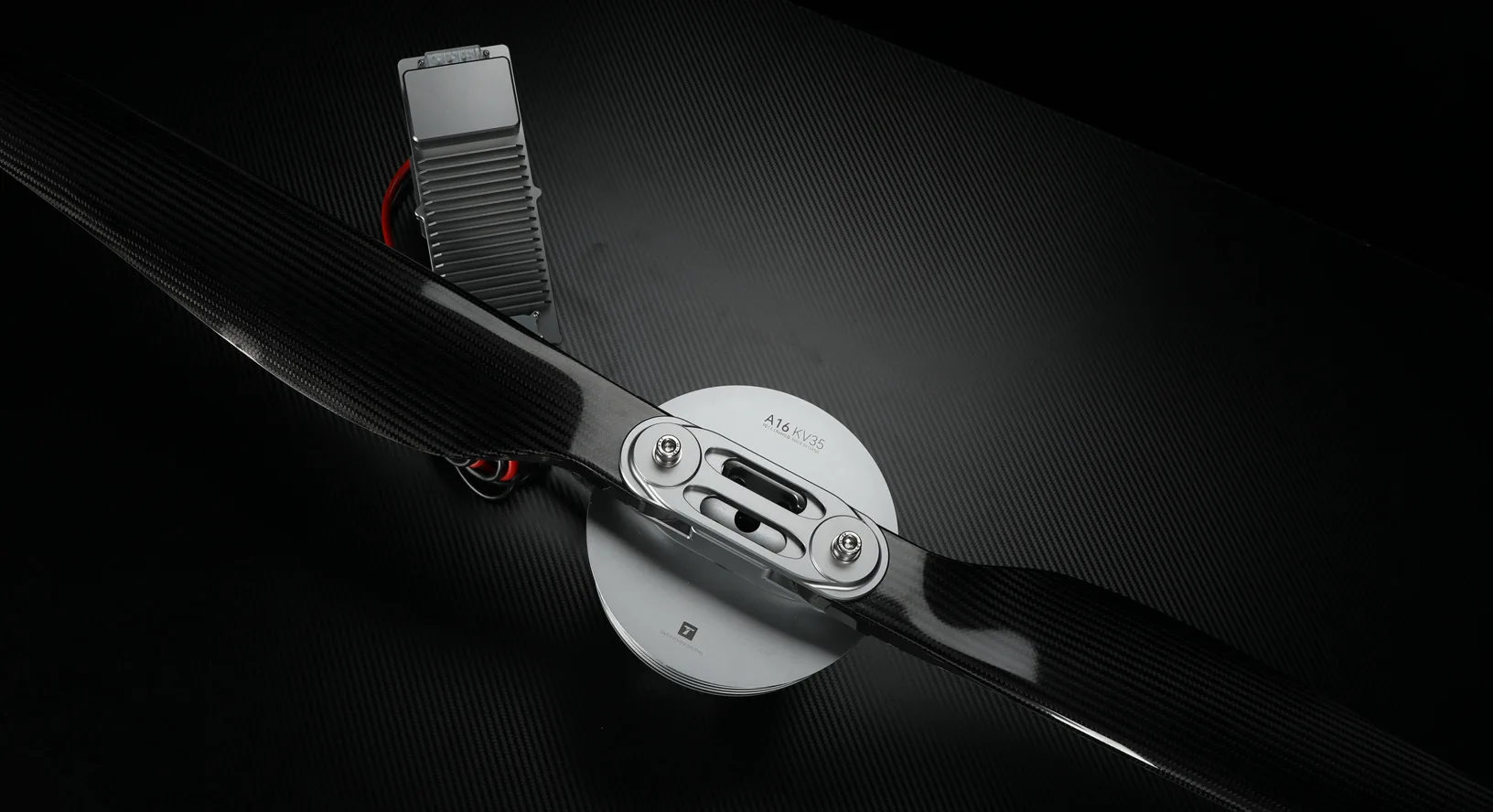
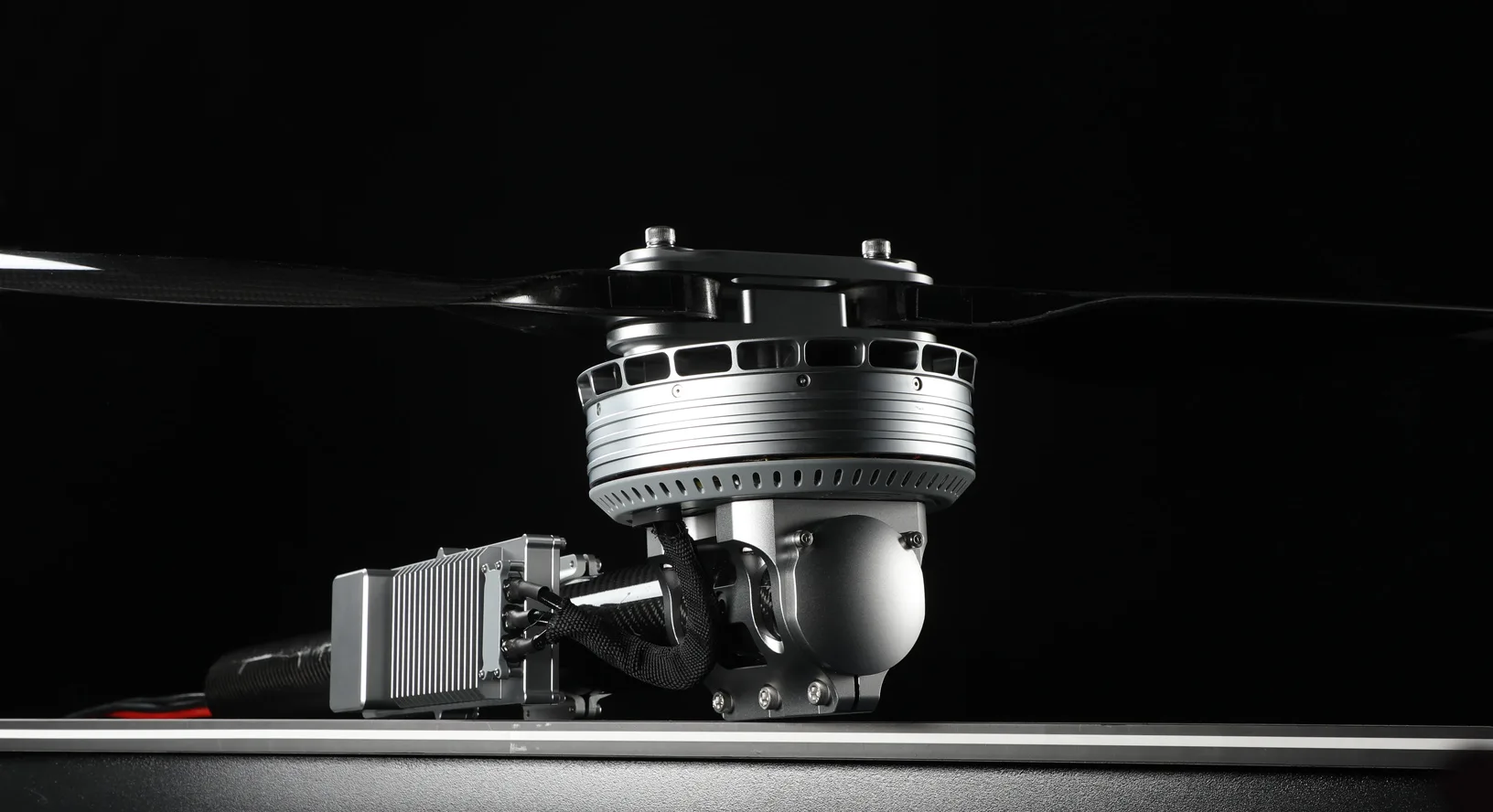
1. A Series - Multirotor Coaxial Modular Power System
If the above solutions don’t meet your needs, feel free to contact us anytime.
Common Pitfalls to Avoid
1. Blindly pursuing “Large Propellers” or “High KV” while ignoring motor overheating
Propellers generate significant aerodynamic drag. If the motor lacks sufficient torque, it cannot reach its rated KV speed. Unused electrical energy turns into heat, pushing the motor coils beyond safe temperatures and causing magnet demagnetization or complete burnout.
2. Ignoring battery discharge capability, leading to severe voltage sag
To cut costs, users sometimes choose a high-capacity battery with a low discharge rate (C-rating). This results in a maximum power supply capability that falls short of the total demand required by the motors. During sudden full-throttle inputs—such as rapid acceleration or emergency obstacle avoidance maneuvers—the insufficient power supply triggers a severe voltage drop, causing the system to go offline. Consequently, the UAV loses power mid-air and crashes in a free fall.
3. Ignoring ESC thermal environment, leading to overheating
When selecting an appropriate ESC, wrapping it tightly with tape inside the arm carbon tubes or placing it within an unventilated center frame compartment just to maintain sleek aesthetics prevents the massive amount of heat generated during operation from dissipating. This lack of airflow ultimately causes the ESC to catch fire and burn out instantaneously.
FAQ
1. Why does the drone lose synchronization after takeoff even when following official recommendations configuration?
Experiencing frequent desynchronization or a coughing-like stutter right after takeoff—commonly referred to in the industry as ESC desync or missing steps—typically occurs during rapid motor acceleration or sudden high-thrust inputs.
Main causes:
Propeller load is too high, causing instantaneous current to exceed the ESC’s momentary capacity and resulting in commutation chaos.
Power wiring is too long or connections are loose, introducing interference that affects the ESC’s normal sampling and judgment.
2. The aircraft flies normally at low altitudes, but the propulsion becomes unstable or briefly loses power at higher altitudes. Why?
This is typically caused by voltage drop, unstable power supply, or insufficient cooling.
Solutions: Shorten power wiring, reinforce terminal connections to prevent loose contacts under high current, and ensure adequate ventilation to avoid ESC thermal protection (which limits power output).
3.The ESC temperature gets extremely high during normal flight. Should I worry about a burnout?
While generating heat during full-load operations is normal, a temperature that exceeds safe limits indicates an underlying system mismatch.
Primary Causes:
The propeller specification exceeds the rated operational envelope of the propulsion system.
The flight throttle percentage runs too high, forcing the system to operate outside its efficiency range.
Solutions:
Reduce the propeller size or pitch to lower the torque demand.
Manage the flight throttle profile to keep it within the recommended operational limits.
Install dedicated cooling mechanisms, such as heatsinks, to effectively lower temperatures.