Agricultural Drone Propulsion System Selection Guide (2026)
Published March:2026-09-16 · Elio
Table of Contents
Share This Article
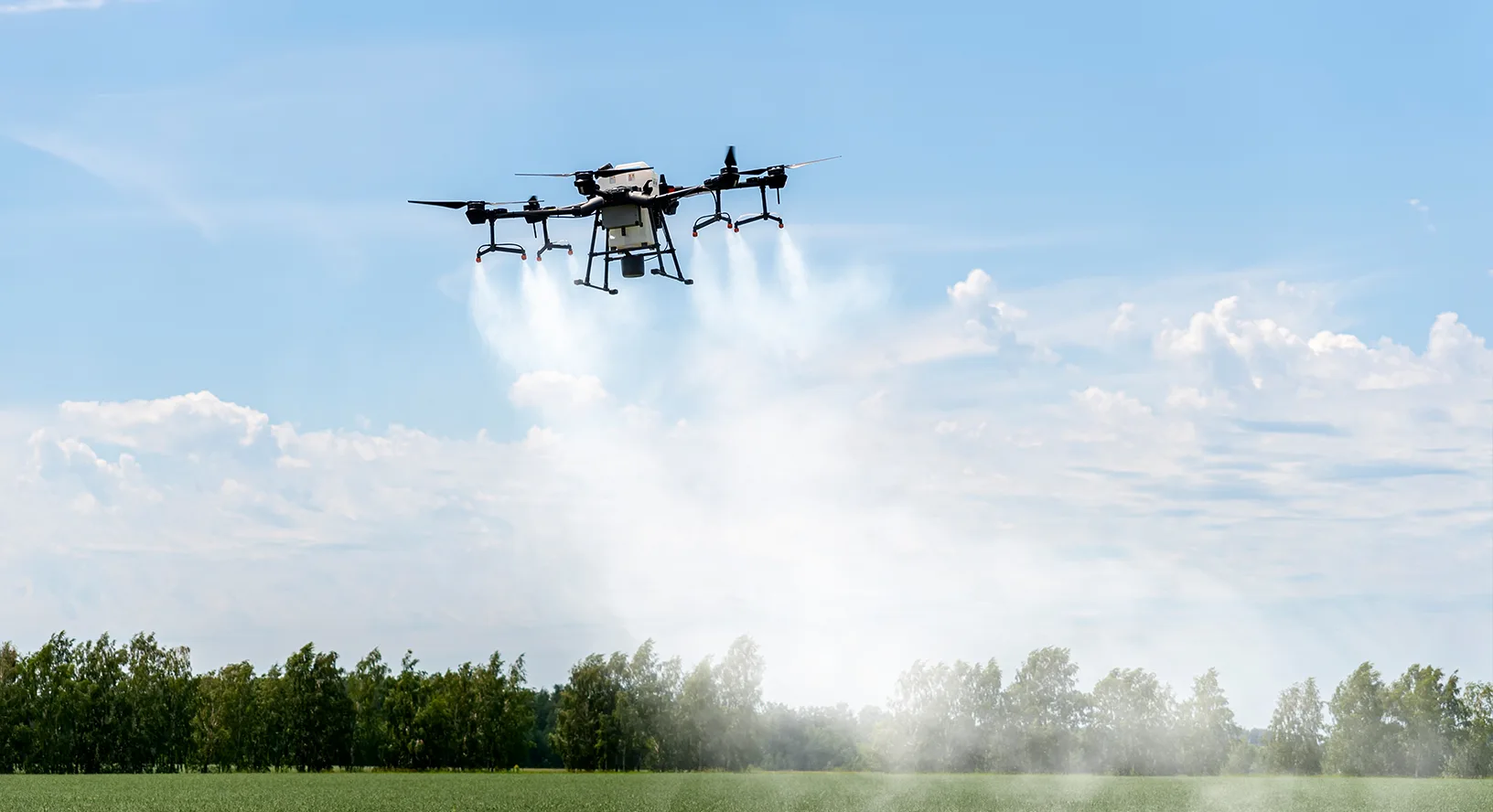
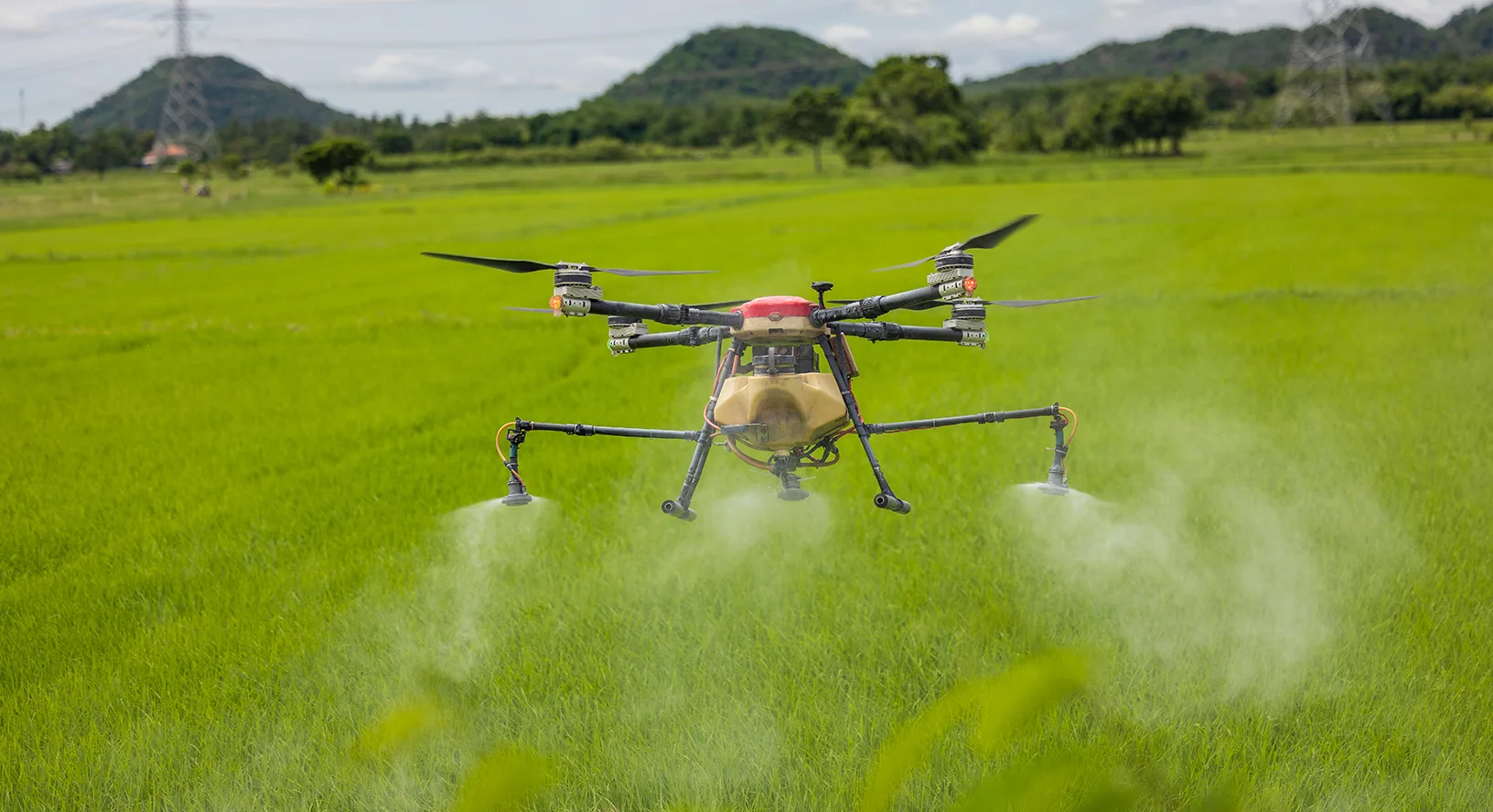
Agricultural UAVs often operate under high payloads, long-duration missions, and challenging conditions such as high temperature, humidity, and liquid spraying. Their propulsion systems must therefore balance thrust, efficiency, thermal management, and reliability.
Propulsion system selection should go beyond motor thrust alone. Motors, propellers, ESCs, and batteries need to be matched based on the aircraft weight, operating conditions, and environment to achieve reliable and efficient performance.
Determining Thrust Requirements
Agricultural drone propulsion system selection should start with the actual payload and aircraft weight. Tank capacity determines the potential payload, while the empty aircraft, battery, and spraying or spreading system all contribute to the maximum takeoff weight (MTOW).
MTOW
MTOW = Payload Weight + Empty Weight
Once the MTOW is determined, the motor count can be used to calculate the load per motor, providing the basis for thrust requirements and motor selection.
Motor Count and Thrust per Motor
For the same MTOW, quadcopters, hexacopters, and octocopters distribute the aircraft weight across different numbers of motors.
Hover thrust per motor ≈ MTOW / Number of Motors
PS:This formula provides a basic hover requirement. Actual selection should also leave sufficient thrust margin for takeoff, climb, wind resistance, and attitude control.
Thrust-to-Weight Ratio (TWR) and Thrust Margin
Hover thrust alone is not enough for real agricultural drone operations. Takeoff, climb, turns, and field winds require additional thrust margin, making thrust-to-weight ratio (TWR) an important factor in propulsion system selection.
Required Total Thrust = MTOW × Target TWR
The appropriate TWR depends on the aircraft structure, payload, flight mission, and operating environment. Once the total thrust requirement is determined, the target thrust per motor can be calculated for motor selection.
Key Motor Selection Parameters
Once the target thrust per motor and maximum thrust are defined, motor selection should focus on overall operating performance rather than peak thrust alone.
Rated Thrust
Rated thrust indicates whether a motor can operate reliably under continuous working conditions. Selection should consider sustained thrust at hover and actual payload loads, while using peak thrust to assess the margin available for takeoff, climb, and wind resistance.
Avoid operating at or near the propulsion system limit during full-load hover. Sufficient thrust margin should be maintained for high-load conditions.
Stator Size
Stator size is closely related to motor torque. Larger propellers generally require more low-speed torque, so the motor should provide torque output suited to the target propeller and payload.
KV Rating
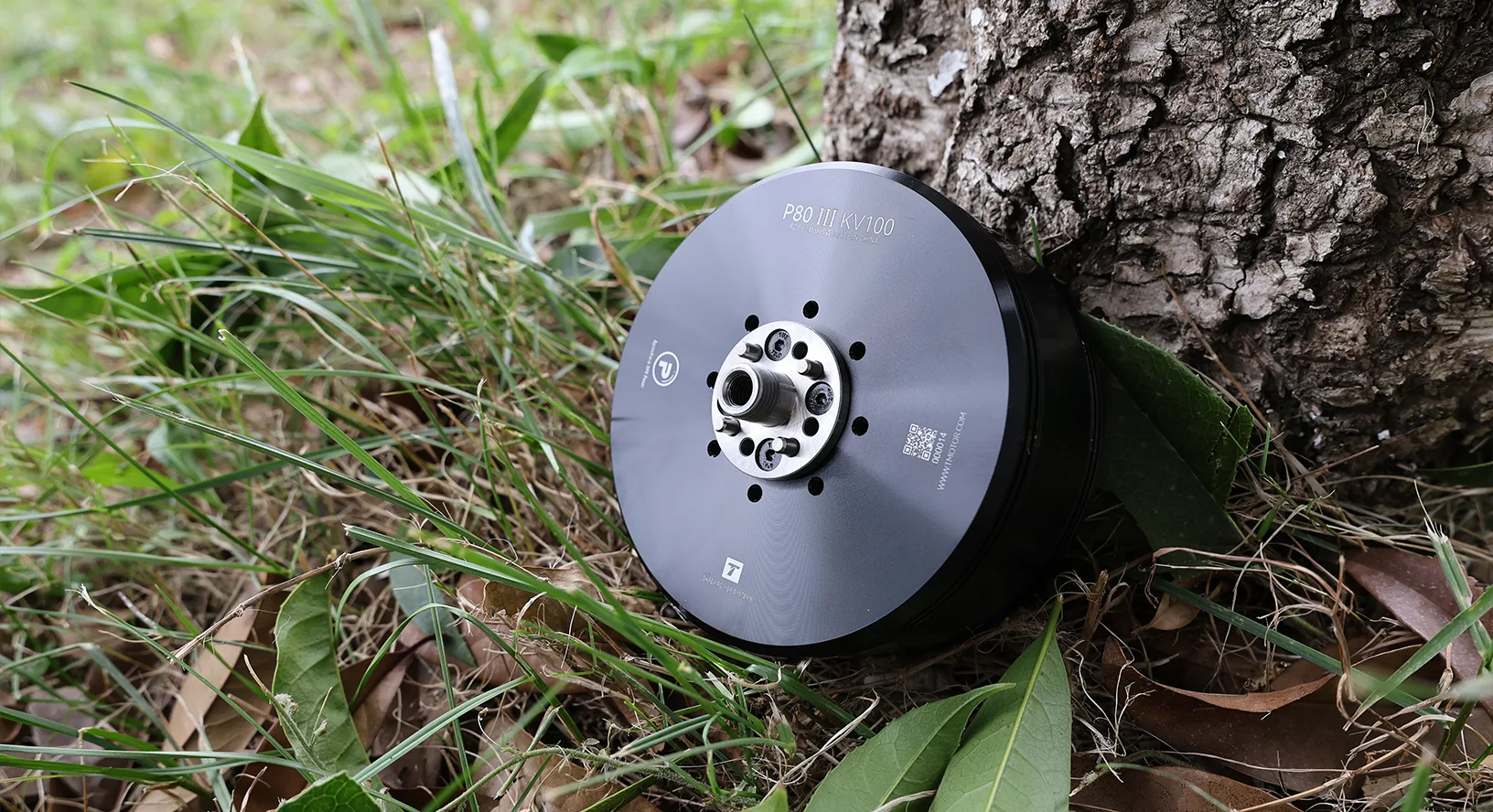
KV indicates the motor's theoretical speed per volt and links battery voltage, motor speed, and propeller selection.
For agricultural drones, KV should be selected based on propeller size and actual operating voltage. In general, lower-KV motors are better suited to higher system voltages and larger propellers. Final selection should be based on test data for the specific motor, propeller, and operating point.
Temperature Resistance
Temperature resistance and thermal management determine whether a motor can withstand sustained high-load operation. Selection should consider winding insulation, allowable operating temperature, and temperature rise under continuous load—not peak performance alone.
Motor and Propeller Matching
Motor performance is affected by propeller aerodynamics, so motor, propeller, operating voltage, and payload should be matched as a system.
Low KV + Large Propellers
For agricultural drones requiring high thrust and longer operation, larger-diameter propellers can move more air at lower speeds, supporting efficient hover performance. Therefore, low-KV motors paired with large propellers are commonly used on heavy-lift agricultural platforms.
Actual efficiency depends on the overall match between the motor, propeller, operating voltage, and payload. It should not be judged by KV or propeller diameter alone.
Propeller Pitch
Propeller diameter, pitch, and speed affect thrust, power consumption, and downwash. For agricultural spraying, pitch should be matched to the downwash required for the application.
A larger pitch generally increases aerodynamic load and power consumption, while an appropriate pitch can help produce downwash suitable for crop canopy penetration. Pitch should therefore be selected based on motor performance, propeller diameter, and spraying conditions.
Carbon Fiber Propellers
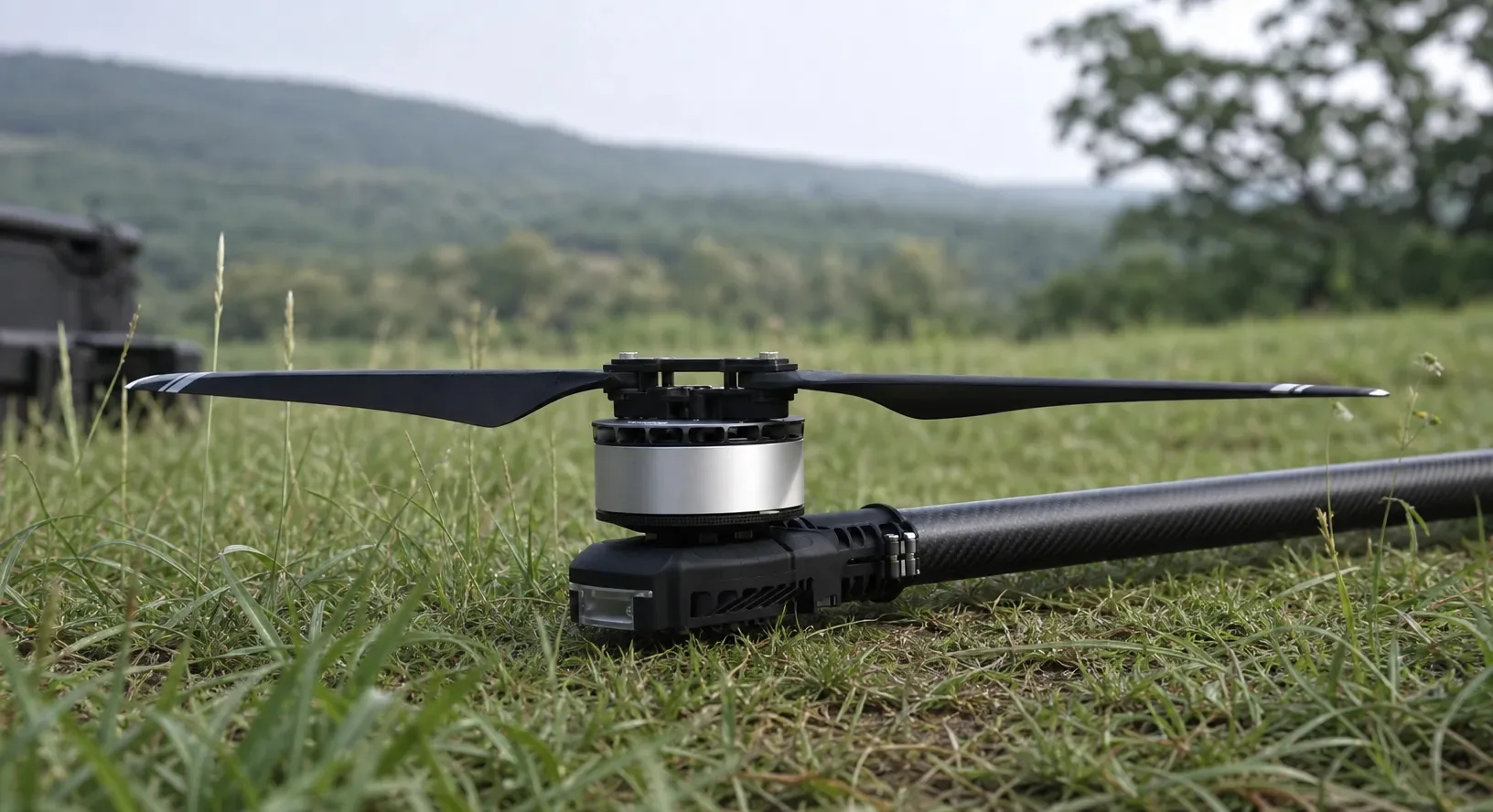
For heavy-lift agricultural drones, carbon fiber composite propellers offer high stiffness and strength, helping maintain blade stability at high rotational speeds.
Precise dynamic balancing helps reduce vibration, while folding designs improve the transport and maintenance of large propellers.
Selecting a Compatible ESC for Agricultural Drones
The ESC connects flight control commands with motor output and is a key part of the agricultural drone propulsion system. Selection should focus on current margin, control method, communication, and telemetry.
Current Margin
The ESC's rated voltage and continuous current should meet the motor's actual operating requirements with a reasonable safety margin. Peak current, ambient temperature, and prolonged full-load operation should also be considered rather than selecting an ESC based only on short-term maximum current.
FOC Control
Field-Oriented Control (FOC) enables more precise control of motor current and magnetic fields, supporting smoother operation and more responsive power output. With proper system matching and control parameters, it can also help reduce operating losses and heat.
For agricultural drones, FOC supports not only efficiency but also power response, smooth operation, and long-term stability.
Communication and Telemetry
Communication and real-time telemetry allow the flight controller to monitor motor and ESC status, including current, voltage, temperature, and fault information.
For long-duration, high-load agricultural drone operations, real-time monitoring helps identify abnormal conditions and improve propulsion system reliability.
Battery Voltage and Energy Efficiency
Propulsion system efficiency is closely related to the supply bus voltage.
High-Voltage Architecture (14S–24S)
At the same power, higher system voltage reduces operating current and therefore lowers resistive power loss.
Heat Loss = I^2 x R
A high-voltage propulsion architecture can reduce wiring losses and current load in high-power agricultural drones. However, system voltage must still be matched with the motor, ESC, battery, and overall electrical architecture.
Mission Profile
Agricultural drones typically take off and operate at full payload, while the aircraft becomes lighter as liquid or granular payload is consumed.
Therefore, battery capacity and voltage architecture should be evaluated against the actual mission cycle rather than full-load flight time alone.
→ Improve Flight Efficiency
Environmental Adaptation: Waterproofing, Corrosion Protection, and Thermal Management
Agricultural drones often operate in demanding conditions involving spray, rain, high temperatures, and pesticide exposure. The propulsion system should therefore provide protection and thermal management suited to the operating environment.
Protection Rating (IPX5 / IPX6)
Agricultural drones are frequently exposed to spray, rain, and cleaning water. When selecting components, check the IP protection ratings of the motor and ESC and whether they have undergone the relevant waterproof testing.
Pesticide Corrosion
Chemicals in pesticides and fertilizers can affect metals, windings, bearings, and electronic components over time. Agricultural propulsion systems should therefore consider material selection, corrosion protection, bearing protection, and electronic component protection. Corrosion resistance is an important factor for long-term spraying operations.
Thermal Management
High ambient temperatures and continuous high-load operation increase the thermal load on motors and ESCs. Selection should consider ambient temperature, continuous load, and temperature-rise test data to evaluate the system's cooling and thermal management performance.
Complete Propulsion System Matching: Individual Components vs. Modular Systems
Agricultural drone propulsion systems can be built through individual component selection or modular propulsion systems (MPET). For high-payload, long-duration platforms, system matching and integration efficiency are equally important.
Individual Component Selection
Individual selection requires separate evaluation of the motor, propeller, and ESC. Key checks include:
Thrust: Does hover and maximum thrust meet mission requirements?
Current: Are continuous and peak currents within the motor and ESC limits?
Thermal performance: Is temperature rise after extended operation within a safe range?
Vibration: Does the motor-propeller combination produce abnormal vibration?
Compatibility: Are the voltage, current, and communication requirements of the motor, propeller, ESC, and battery matched?
Engineering Advantages of Modular Propulsion Systems
A modular propulsion system coordinates core components such as the motor, propeller, and ESC, reducing the complexity of individual selection and system integration.
For agricultural drone manufacturers, a validated modular propulsion system can help:
Reduce propulsion matching and integration effort
Shorten aircraft development cycles
Lower system integration risk
Improve batch consistency
T-MOTOR Agricultural Drone Propulsion
T-MOTOR provides industrial-tested agricultural UAV propulsion solutions covering platforms from 10L-class lightweight spraying drones to 70L+ heavy-payload spreading platforms.
Selecting a propulsion system for an agricultural drone is not simply about choosing a high-thrust motor. It requires system-level matching of thrust, motor, propeller, ESC, battery, and environmental adaptability based on MTOW and mission requirements.
A well-matched system should meet thrust requirements while balancing efficiency, thermal management, and long-term reliability. For agricultural drone projects requiring rapid development, batch deployment, or customized propulsion solutions, a validated integrated system can further reduce matching and system integration effort.
Q1: How do I choose a motor for an agricultural drone?
Select the motor based on MTOW, motor count, target thrust, and operating conditions, then match it with the system voltage, KV, propeller, and efficiency.
Q2: How much thrust does an agricultural drone need?
Determine total thrust from MTOW and the target thrust-to-weight ratio, then calculate the required thrust per motor based on motor count.
Q3: What KV motor is suitable for an agricultural drone?
KV should be selected based on battery voltage, propeller size, target speed, and required thrust rather than considered alone.
Q4: How do I match a motor and propeller for an agricultural drone?
Consider KV, operating voltage, propeller diameter, pitch, thrust, torque, and power consumption.
Q5: How do I choose an ESC for an agricultural drone?
Choose an ESC with sufficient rated voltage and continuous current capacity, plus a reasonable safety margin. Also consider control, communication, and telemetry.
Q6: How can I increase agricultural drone flight time?
Reduce aircraft weight, optimize motor-propeller matching, improve propulsion efficiency, and optimize the battery voltage architecture.